Copper nanowires are relaxed with axial periodic and lateral free traction B.C.. However, the results give non-zero radial stress Sigma_rr at free surface, which does not valish even after average over the nanowire volume. The radial distribution from nanowire center to free surface of Sigma_rr is as given below. The average Sigma_rr over entire nanowire gives compressive value correlated linearly with inverse nanowire diameter, which makes it not like numerical error. Anybody share some information why is that? The atomic stress is calculated using Virial stress.The nanowire has circular cross-section.
| Attachment | Size |
|---|---|
| s11-radial-20nm-nw.JPG | 43.23 KB |
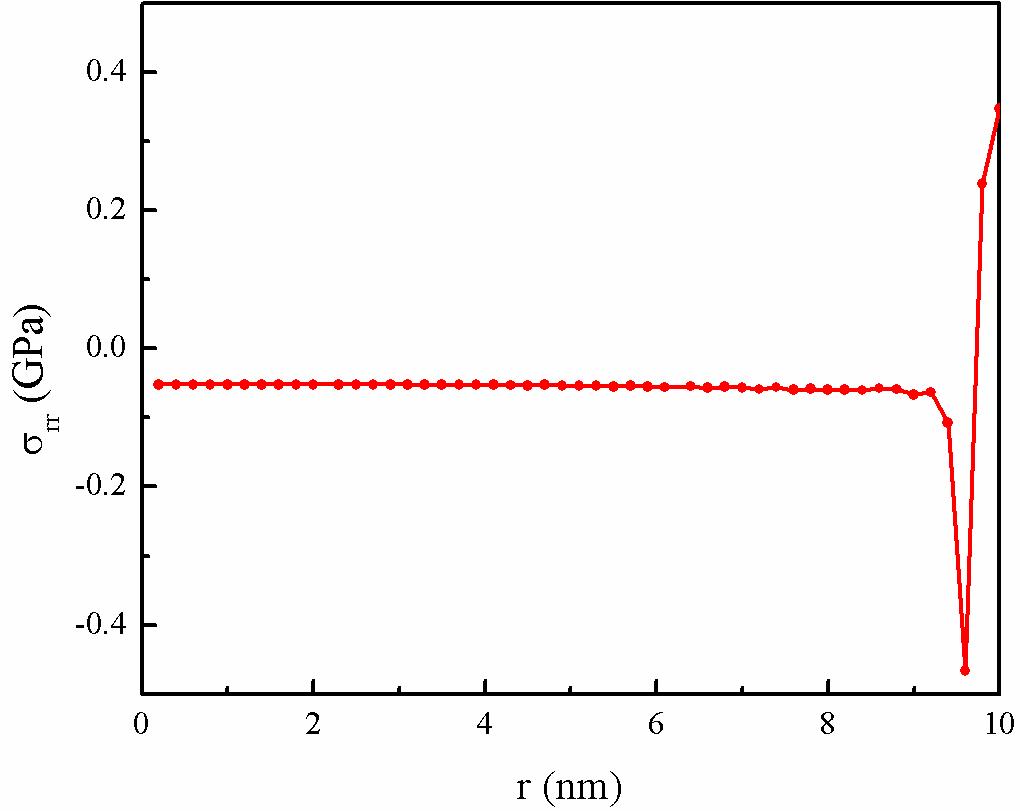
The figure
Sorry I don't know how to upload the pic.
surface effect?
It appears to be a surface effect: both surface energy and surface stress can induce residual stresses inside nanowires. You may want to check out some discussions in a previous journal club: http://www.imechanica.org/node/2216 .
RH
In reply to surface effect? by Rui Huang
Hi Dr Huang, thanks very
Hi Dr Huang, thanks very much for your comment.
I understood the residual stress induced inside nanowires by surface relaxation.The distribution in attched figure is just like what I expected. I also expected that the summation of Sigma_rr over all the atoms (include both the surface and interior) gives zero since no external force is applied. But the results tell a different story which makes me confused. For a nanowire of 20nm diameter, the averaged result over all atoms gives a compressive Sgima_rr of 0.05 GPa. This value is too high to be numerical error, in addtion to its correlation with nanowire diameters.
I am looking at the reference you shared to find some clue and will be very glad to hear more from you.
Many thanks.
Yongfeng
In reply to surface effect? by Rui Huang
average radial stress
Yongfeng,
If you simply add all the radial stress components (Sigma_rr) and take the average, the result is not zero. Consider a spherical water drop with surface tension. A uniform pressure develops in the water to balance the surface tension. The relation between the internal pressure and the surface tension is given by the well-known Young's equation. Consequently, the average radial stress in the water would be the same as the inner pressure (not zero). Similar equation can be developed for solid particles or nanowires, but could be more complicated due to the fact that surface properties of solids are more sophisticated than just surface tension for water.
RH
In reply to average radial stress by Rui Huang
Hi Dr Huang, Thanks a lot
Hi Dr Huang,
Thanks a lot for both your comments and references! Actually, the correlation between the nanowire diameter and the residual stress has pointed me to the Young's equation. But I was not confident then. Now I can move on with mywork.
Best regards!
Yongfeng