Ke Liu
Department of Advanced Manufacturing and Robotics, Peking University, Beijing, China
Introduction
The mechanical properties of most current architected materials arise from periodically tessellated unit cells. Although periodicity in conventional architected materials promises homogeneity and predictability in mechanical behaviors, it imposes a strong restriction on the design space of architected materials. On the other hand, irregular architected materials are characterized by disordered and aperiodic microstructures. They are ubiquitous in nature, enabling functionally graded properties, finely optimized for purposes such as homeostasis regulation, tissue remodeling, body protection, flight agility, and stress shielding. Examples of such materials include wood, seashells, bone, spider silk, turtle shells, and bird feathers, showcasing showcase the remarkable ability to balance strength and flexibility, offering valuable lessons for material design.
Today's discussion will delve into the novel methodologies outlined in recent studies for irregular architected materials, ranging from design to potential applications. We will first discuss algorithms for the design and generation of irregular architected materials. For example, the virtual growth program outlined in [1], and how multiscale structures with tailored responses can be achieved through topology optimization [2,3,4]. These approaches allow for precise control over material distribution, facilitating applications in biomechanics, robotics, and advanced manufacturing. We will explore how these computational frameworks bridge the gap between natural inspiration and engineered innovation, paving the way for enhanced material performance and manufacturability.
Generation of irregular microstructures
To understand how structural irregularity relates to material properties, algorithms to systematically generate such structures are necessary. There are in general two types of algorithms for generation of irregular architected materials: (1) substrative and (2) additive.
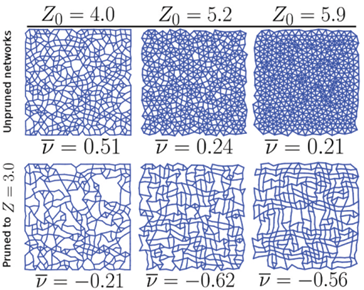
A typical example for subtractive approach is the random lattices in references [5,6]. Reid et al. [5] generate auxetic lattices through a systematic pruning strategy applied to disordered networks of nodes connected by bonds. The process involves selectively removing bonds from an initially disordered, jam-packed network. Mirzaali et al. [6] begin with random node placement, either in a predefined grid (lattice-restricted) or randomly within a bounded spatial region (unrestricted). Bonds are then formed between nodes within a specified maximum distance, ensuring a minimum connectivity of 2 for structural coherence, while designs with isolated substructures are discarded, resulting in networks with varying connectivity levels and mechanical behaviors. However, subtractive approaches are quite limited to lattices. For other types of microstructural designs, they become inefficient to explore the vast design space.
Figure 1. Subtractive design of irregular auxetic lattices through selective pruning [5].
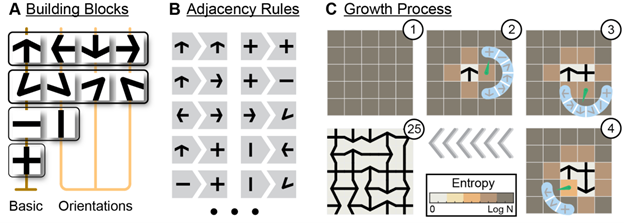
Additive approaches typically involve sampling from a random distribution. This distribution can be explicitly defined, such as the spinodal structures generated by Gaussian random field [7,8,9]. This distribution can also be implicitly defined, such as the virtual growth program as introduced in [1]. The virtual growth program provides a versatile encoding of material microstructures, which is a graph-based method that builds on the combinatorial space of some predefined basic building blocks. These building blocks are local structural elements that can be identified in arbitrarily complex microstructures at a scale that is smaller than the typical unit cells in periodic designs. In the virtual growth process, the building blocks are connected stochastically on an underlying graph, in which each pair of neighbors abides prescribed adjacency rules. Because the basic building blocks can be any type of geometries, the virtual growth rule can thus be used to generate lattices, composites, and cellular structures. Due to these advantages, this post will mainly focus on the virtual growth program generated irregular architected materials.
Figure 2. Illustration of the virtual growth program [1].
In the virtual growth process, the design area is first divided into small patches connected by an underlying network. The elements are to be randomly filled one-by-one with pre-defined building blocks. During the random filling process, the probability of appearance of each building block must obey prescribed values (a.k.a. frequency hint), and the adjacent pair of building blocks must obey local connectivity rules. The local connectivity rule determines the pair-wise compatibility, which is defined to ensure good connections between neighboring building blocks and avoid the formation of detached sub-regions. Once a grid is filled, only compatible building blocks can be assigned to its nearby grids. This prevents the formation of unwanted local structures. This iterative process runs until all patches are filled.
Convergence of properties for virtual growth generated materials
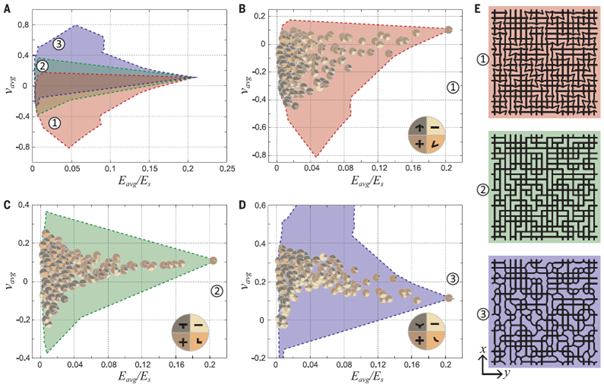
Several paper have confirmed that despite of the randomness and irregularity of the local structures, the global properties of the irregular architected materials exhibit regulatable properties by controlling rules during the growth process. In the original paper [1], it is shown that linear elastic properties, such as Young’s modulus and Poisson’s ratio, can be effectively determined by the shapes and frequency hints of building blocks. Liu et al. [10] further show that these materials exhibit consistent sound absorption and deformation resistance under the same frequency hints, while demonstrating significant variability with different combinations of frequency hints. The sound chamber characteristics, including number and shape, are identified as key factors underpinning these properties. In our recent paper, Wang et al. [11] show that nonlinear properties, including yield strength and specific energy absorption, are also strongly correlated with the frequency hints of the building blocks and their local connectivity.
Figure 3. Diversity and convergence of material properties offered by irregular architected materials [1].
These work show that probabilistic growth rules generate architected materials with predictable property convergence, enabling robust performance while supporting tailored diversity. The statistical clustering of properties validates these approaches as reliable tools for designing customizable materials. Together, they underscore the potential of stochastic methods to mimic nature’s efficiency, paving the way for scalable and adaptable engineering solutions.
Optimization of heterogeneous distribution
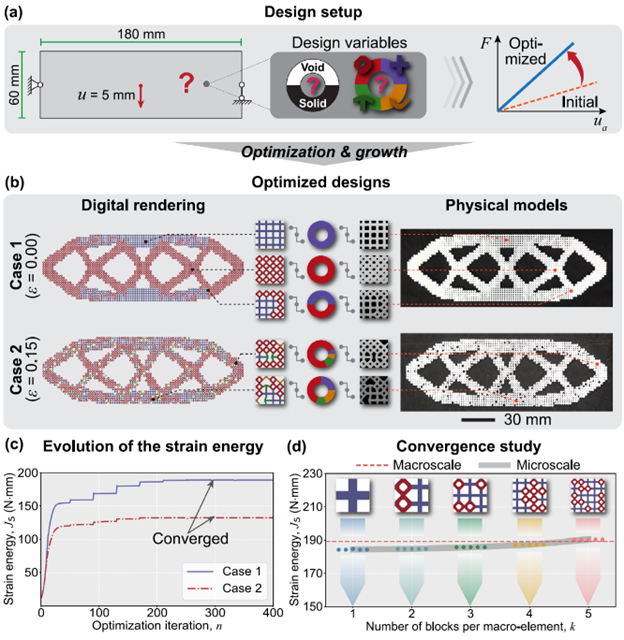
The above discussion show that we can relate material properties with the growth rules. Therefore, all elements are ready be used for the design of bio-inspired functional structures made of materials with irregular microstructures. In a series of research, Jia et al. [2,3,4] show that by leveraging topology optimization algorithm to tailor the spatial distribution of irregular microstructures with different properties, multiscale structures with desired global behavior can be achieved, including mechanical cloaking, tunable strain energy density, global stiffness, and local stress distribution. In the multiscale topology optimization, a database of material properties is first created by sampling frequency hints and generating corresponding microstructures. Elasticity tensors for these samples are computed via numerical homogenization. Then a neural network is trained to establish a continuous and differentiable relationship between frequency hints and elasticity tensors. Finally, gradient-based topology optimization is performed to optimize the spatial distribution of elastic properties for desired performance. This optimized distribution of elasticity tensors can be directly translated to frequency hints by the pretrained neural network that guides the growth of irregular microstructures.
Figure 4. Multiscale design of a planar beam with maximized overall structural stiffness [3].
We highlight that this approach does not impose strict limitations on either the quantity or the geometrical configurations of the building blocks, thereby enabling the creation of intricate aperiodic multiscale structures. The generated multiscale structures exhibit stochastic, self-sustaining ensembles composed of given building blocks. There is no interfacial issue between regions of microstructures with different properties. Furthermore, the building blocks are chosen to ensure a manufacturable minimum feature size, avoiding any delicate or protruding elements. This inherent self-supporting property, combined with the established minimum feature size, greatly enhances the feasibility of manufacturing these optimized structures via 3D printing. In a recent paper [4], the authors further extend the framework to incorporate transformations of the building blocks (scaling, skew, and rotation), in order to generate metastructures with various optimized mechanical functionalities. The transformation-based topology optimization ensures these metastructures naturally conform to the boundaries of the design domain and can serve as mechanical infills.
Potential application as optimal tissue support
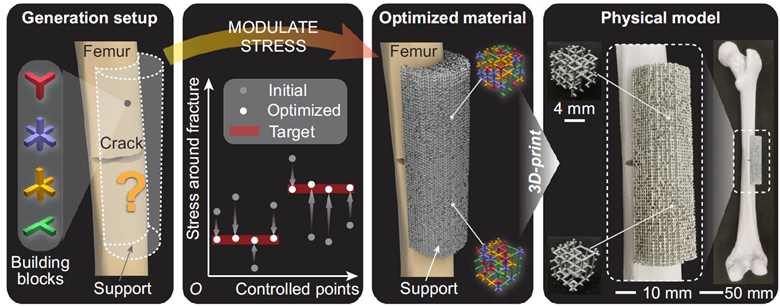
One of the important potential application of the optimized irregular architected metastructures is for optimal tissue support, as demonstrated in ref. [2]. This paper explores the potential application of bio-inspired irregular architected materials for orthopedic femur restoration by leveraging their ability to modulate stress distribution. A generative computational framework combines a material property optimizer and a virtual growth simulator to create disordered microstructures optimized for stress modulation. These structures can precisely control shear stress levels at desired regions, stimulating bone regeneration while avoiding adverse effects like fully stress shielding associated with traditional metal plates. Experimentally validated via 3D printing, the optimized materials maintain uniform stress modulation across complex geometries, offering a promising solution for orthopedic applications.
Figure 5. Potential application of the irregular architected materials for orthopedic femur restoration [2].
Further discussions
· What other regulatable material properties can be offered by irregular architected materials? Such as fracture strength, ductility, etc.
· Irregular architected materials are of higher entropy compared to periodic designs, so they must be easier to achieve through self-assembly. Is there possibility to create new manufacturing methods for such materials so that this feature can be utilized.
· Can we derive closed-form expressions for the probabilistic relationship between growth rules and material properties?
References:
[1] K. Liu, R. Sun, C. Daraio. Growth rules for irregular architected materials with programmable properties, Science, 377, 975–981, 2022.
[2] Y. Jia, K. Liu, X. S. Zhang. Modulate stress distribution with bio-inspired irregular architected materials towards optimal tissue support, Nature Communications, 15, 4072, 2024.
[3] Y. Jia, K. Liu, X. S. Zhang. Topology optimization of irregular multiscale structures with tunable responses using a virtual growth rule, Computer Methods in Applied Mechanics and Engineering, 425:116864, 2024.
[4] Y. Jia, K. Liu, X. S. Zhang. Unstructured growth of irregular architectures for optimized metastructures, Journal of the Mechanics and Physics of Solids, 192:105787, 2024.
[5] D. R. Reid, N. Pashine, J. M. Wozniak, H. M. Jaeger, A. J. Liu, S. R. Nagel, J. J. de Pablo. Auxetic metamaterials from disordered networks, Proc. Natl Acad. Sci., 115:E1384–E1390, 2018.
[6] M. J. Mirzaali, H. Pahlavani, A. A. Zadpoor. Auxeticity and stiffness of random networks: Lessons for the rational design of 3D printed mechanical metamaterials, Appl. Phys. Lett., 115:021901, 2019.
[7] C. M. Portela, A. Vidyasagar, S. Krödel, T. Weissenbach, D. W. Yee, J. R. Greer, D. M. Kochmann. Extreme mechanical resilience of self-assembled nanolabyrinthine materials, Proc. Natl Acad. Sci., 117: 5686–5693, 2020.
[8] L. Zheng, S. Kumar, D. M. Kochmann, Data-driven topology optimization of spinodoid metamaterials with seamlessly tunable anisotropy. Computer Methods Appl. Mech. Eng., 383: 113894, 2021.
[9] F. V. Senhora, E. D. Sanders, G. H. Paulino. Optimally-Tailored Spinodal Architected Materials for Multiscale Design and Manufacturing, Adv. Mater., 34:2109304, 2022.
[10] Y. Liu, B. Xia, K. Liu, Y. Zhou, K. Wei. Robustness and diversity of disordered structures on sound absorption and deformation resistance, Journal of the Mechanics and Physics of Solids, 190:105751, 2024.
[11] R. Wang, Y. Bian, K. Liu. Nonlinear mechanical properties of irregular architected materials, Journal of Applied Mechanics, accepted.
| Attachment | Size |
|---|---|
| Picture1.png | 154.8 KB |
| Picture2.png | 76.26 KB |
| Picture3.png | 201.43 KB |
| Picture4.png | 370.18 KB |
| Picture5.png | 318.44 KB |