The full paper can be found at:
https://authors.elsevier.com/c/1b2plc7qwXwm0
Abstract:
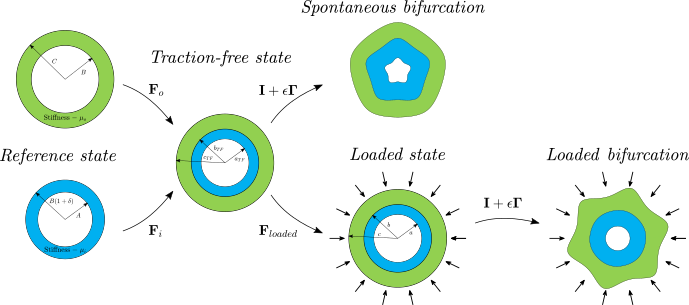
Geometric incompatibilities are ubiquitous in natural structures and are recently being exploited in synthetic
structures to enhance the performance of soft systems. In this work we focus on infinitely long bi-layer
neo-Hookean tubes with radial incompatibilities, i.e. the outer radius of the inner tube is different than the inner
radius of the outer tube. The two tubes are radially stretched or compressed to form a single perfectly adhered
bi-layer tube. We show that radial incompatibility gives rise to a residual stress which may lead to spontaneous
bifucations, i.e. a circumferential transition into a non-circular cross-section in the absence of an external loading
(such as in mucosal folding). Interestingly, this work reveals that spontaneous instabilities do not always occur
in bi-layer neo-Hookean tubes. This stems from the presence of a saturation pressure that is associated with this
hyperelastic model under inflation. To elucidate this effect, we present maps that reveal which combinations
of geometries and stiffness ratios between the two tubes lead to spontaneous bifurcations. This finding perhaps
underscores the main drawback of the neo-Hookean model and its use in instability analyses of cylindrical configurations.
With the aim of exploiting the proposed framework to enhance the performance of tubular systems,
we investigate the mechanical benefit of radial incompatibility in bi-layer tubes in terms of maximum inflation
pressure, stiffness, and critical buckling load. We show that appropriate design of the radial incompatibility can
result in significant enhancements in the overall stiffness and the inflation pressure or a mild increase in the bifurcation
load.
| Attachment | Size |
|---|---|
| fig_1_mappings_v4_small.png | 62.22 KB |