Mechanics
Mechanics is the paradise of
the mathematical sciences
because by
means of it
one comes to the fruits
of mathematics.
Leonardo da Vinci (1452-1519)
Mechanics is the paradise of
the mathematical sciences
because by
means of it
one comes to the fruits
of mathematics.
Leonardo da Vinci (1452-1519)
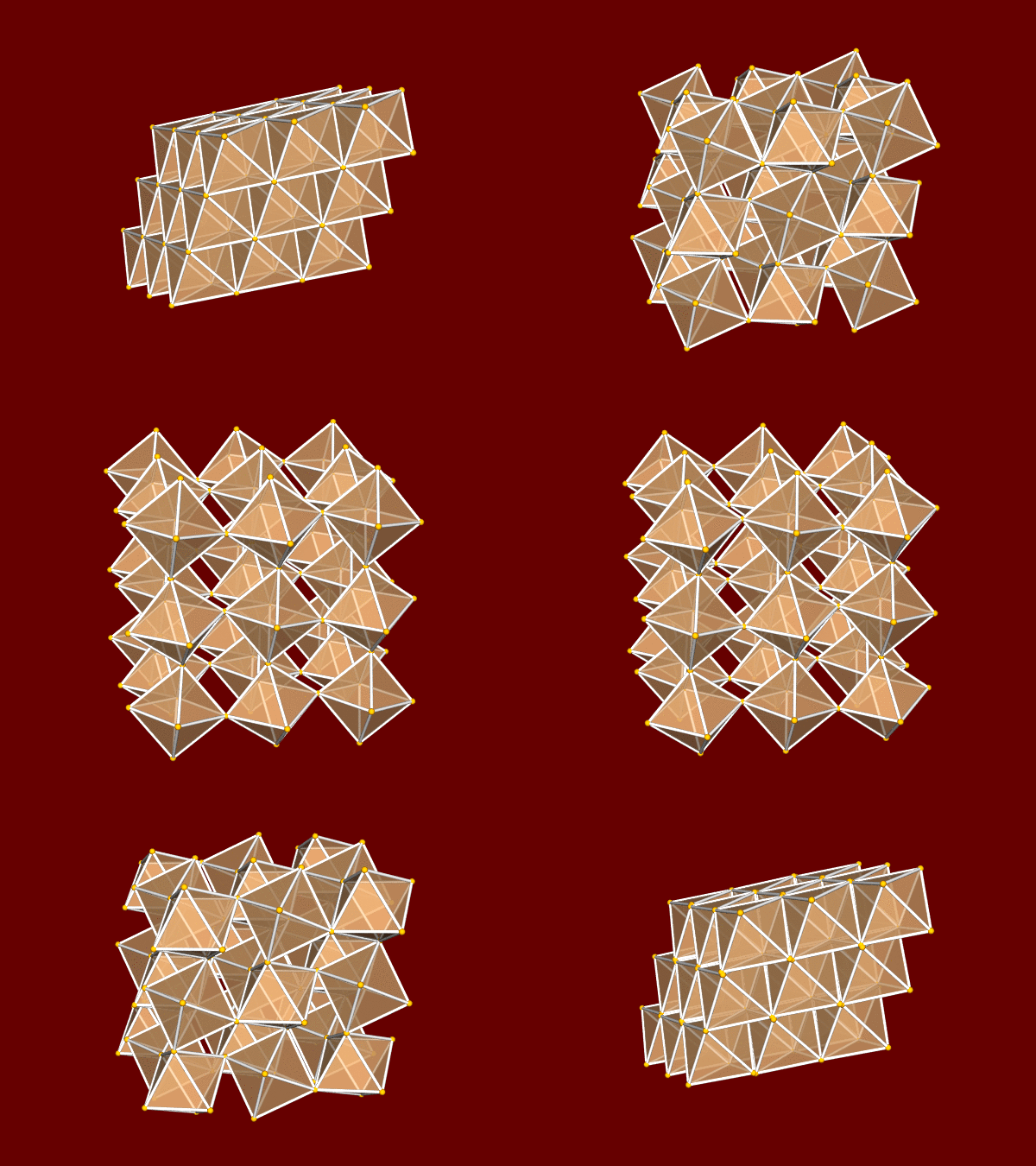
In this paper we extend the classical method of lattice dynamics to defective crystals with partial symmetries. We start by a nominal defect configuration and first relax it statically. Having the static equilibrium configuration, we use a quasiharmonic lattice dynamics approach to approximate the free energy. Finally, the defect structure at a finite temperature is obtained by minimizing the approximate Helmholtz free energy. For higher temperatures we take the relaxed configuration at a lower temperature as the reference configuration.
Can anybody help me with piezoelectric modeling using abaqus cae? I am pretty new on this, I am looking at tutorials or *.cae files but I cannot find any. can you please reference me where to find them or maybe explain how it works? Thanks
Hi all...........
hi...i m doing 2nd year mtech...i m getting an error while solving circumferential crack in cylinder using ANSYS...while calculating stress intensity factor(SIF) it shows the error as "all crack face nodes do not have the same z value in the currently active coordinate system"...please anyone let me know how to deal this error??
regards
sunil kumar
Dear iMechanica users,
I would like to write a UEL for 2 or 3D element types used in large deformation, but, I really have little experience in it. Is there any UEL example apart from the simple 1D example in Abaqus manual and the complicated one written by Eugenio (XFEM)?
Thanks,
Hadi
Hi all,
I am starting to my phd project focusing on developing new interatomic potentials.
Would you please help introduce some of current research trends(such as review paper, existed potentials etc) on this field.
Thanks.
The Integrated Structure Technical Committee in the Applied Mechanics Division of ASME invite you to submit an abstract to the Symposium on Mechanics of Integrated Structures and Hybrid Materials in Advanced Technologies at the 2010 ASME International Mechanical Engineering Congress & Exposition (IMECE).
Date: November 12-18, 2010
Venue: Vancouver, British Columbia, Canada.
Hi,
I have to use Hamilton pricinple to evaluate the diff. equation of motion of a string. As shown in the figure below, the string is hanged from one end and is free at the other. The flexural stiffness of the string is negligible.
I have a problem with the potential energy of the string! required in the Hamilton principle. Since the flexural stiffness of the string is assumed to be negligible, is there any other term for potential energy?
Testing