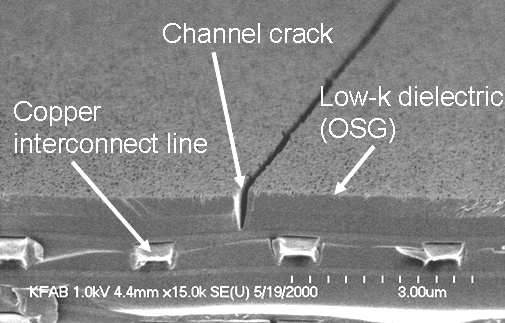
channel crack
Influence of Interfacial Delamination on Channel Cracking of Brittle Thin Films
Submitted by Rui Huang on Sat, 2007-12-08 04:06.
H. Mei, Y. Pang, and R. Huang, International Journal of Fracture 148, 331-342 (2007).
Following a previous effort published in MRS Proceedings, we wrote a journal article of the same title, with more numerical results. While the main conclusions stay the same, a few subtle points are noted in this paper.
First, instead of using the approximate formula by Ye, Suo and Evans (1992), we calculate the energy release rate of interfacial delamination emanating from the channel crack exclusively by the finite element method. We found that the approximate formula is not accurate in several cases.
- Rui Huang's blog
- Login or register to post comments
- Read more
- 675 reads
Influence of Interfacial Delamination on Channel Cracking of Brittle Thin Films
Submitted by Yaoyu Pang on Tue, 2007-04-10 18:47.Channeling cracks in low-k dielectrics have been observed to be a key reliability issue for advanced interconnects. The constraint effect of surrounding materials including stacked buffer layers has been studied. This paper analyzes the effect of interfacial delamination on the fracture condition of brittle thin films on elastic substrates. It is found that stable delamination along with the growth of a channel crack is possible only for a specific range of elastic mismatch and interface toughness. An effective energy release rate is defined to account for the influence of interfacial delamination on both the driving force and the fracture resistance, which can be significantly higher than the case assuming no delamination.
- Yaoyu Pang's blog
- 3 comments
- Read more
- 2074 reads
Channel cracks in a hermetic coating consisting of organic and inorganic layers
Submitted by Nicolas Cordero on Fri, 2007-01-12 20:26.Abstract: Flexible electronic devices often require hermetic coatings that can withstand applied strains. This paper calculates the critical strains for various configurations of channel cracks in a coating consisting of organic and inorganic layers. We show that the coating can sustain the largest strain when the organic layer is of some intermediate thicknesses.
Flexible electronics are promising for diverse applications, such as rollable displays, conformal sensors, and printable solar cells. These systems are thin, rugged, and lightweight. They can be manufactured at low costs, for example, by roll-to-roll printing. The development of flexible electronics has raised many issues concerning the mechanical behavior of materials. This paper examines a particular issue: channel cracks in hermetic coatings.
Electronic devices (e.g., organic light-emitting devices, OLEDs) often degrade when exposed to air. Developing hermetic coatings has been a significant challenge. Organic films are permeable to gases, and inorganic films inevitably contain processing flaws, so that neither by themselves are effective gas barriers. These considerations have led to the development of multilayer coatings consisting of alternating organic and inorganic films. To be used in flexible electronics, these coatings must also withstand applied strains without forming channel cracks...
- Nicolas Cordero's blog
- 2 comments
- Read more
- 2016 reads
Environmental Effects on Crack Characteristics for OSG Interconnect Materials
Submitted by Jeannette Jacques on Mon, 2006-11-06 21:59.Jeannette M. Jacques, Ting Y. Tsui, Andrew J. McKerrow, and Robert Kraft
To improve capacitance delay performance of the advanced back-end-of-line (BEOL) structures, low dielectric constant organosilicate glass (OSG) has emerged as the predominant choice for intermetal insulator. The material has a characteristic tensile residual stress and low fracture toughness. A potential failure mechanism for this class of low-k dielectric films is catastrophic fracture due to channel cracking. During fabrication, channel cracks can also form in a time-dependent manner due to exposure to a particular environmental condition, commonly known as stress-corrosion cracking. Within this work, the environmental impacts of pressure, ambient, temperature, solution pH, and solvents upon the channel cracking of OSG thin films are characterized. Storage under high vacuum conditions and exposure to flowing dry nitrogen gas can significantly lower crack propagation rates. Cracking rates experience little fluctuation as a function of solution pH; however, exposure to aqueous solutions can increase the growth rate by three orders of magnitude.
- Jeannette Jacques's blog
- Login or register to post comments
- Read more
- 1527 reads
Pattern Effect on Low-k Channel Cracking
Submitted by Xiao Hu Liu on Fri, 2006-11-03 02:23.Low dielectric constant (low-k) is achieved often at the cost of degraded mechanical properties, making it difficult to integrate the dielectric in the back end of line (BEOL) and to package low-k chips. Development of low-k technology becomes costly and time-consuming. Therefore, more frequently than before, people resort to modeling to understand mechanical issues and avoid failures. In this paper we present three multilevel patterned film models to examine channel cracking in low-k BEOL. The effects of copper features, caps and multilevel interconnects are investigated and their implications to BEOL fabrication are discussed.
Low-k BEOL Mechanical Modeling
Liu, Xiao Hu; Lane, Michael W; Shaw, Thomas M; Liniger, Eric G; Rosenberg, Robert R; Edelstein, Daniel C
Advanced Metallization Conference 2004 (AMC 2004); San Diego, CA and Tokyo; USa and Japan; 19-21 Oct. 2004 and 28-29 Sept. 2004. pp. 361-367. 2005
- Xiao Hu Liu's blog
- 1 comment
- 2144 reads
Constraint Effects on Thin Film Channel Cracking Behavior
Submitted by Ting Tsui on Sun, 2006-09-24 20:59.
One of the most common forms of cohesive failure observed in brittle thin film subjected to a tensile residual stress is channel cracking, a fracture mode in which through-film cracks propagate in the film. The crack growth rate depends on intrinsic film properties, residual stress, the presence of reactive species in the environments, and the precise film stack. In this paper, we investigate the effect of various buffer layers sandwiched between a brittle carbon-doped-silicate (CDS) film and a silicon substrate on channel cracking of the CDS film. The results show that channel cracking is enhanced if the buffer layer is more compliant than the silicon substrate. Crack velocity increases with increasing buffer layer thickness and decreasing buffer layer stiffness. This is caused by a reduction of the constraint imposed by the substrate on the film and a commensurate increase in energy release rate. The degree of constraint is characterized experimentally as a function of buffer layer thickness and stiffness, and compared to the results of a simple shear lag model that was proposed previously. The results show that the shear lag model does not accurately predict the effect of the buffer layer. (J. Mater. Res., Vol. 20, No. 9, Sep 2005)
- Ting Tsui's blog
- Login or register to post comments
- Read more
- 2196 reads
Experimental determination of crack driving forces in integrated structures
Submitted by Zhigang Suo on Fri, 2006-09-15 12:38.- Zhigang Suo's blog
- 14 comments
- Read more
- 5987 reads


Recent comments
17 min 20 sec ago
1 hour 50 min ago
8 hours 55 min ago
18 hours 31 min ago
1 day 5 hours ago
1 day 14 hours ago
1 day 17 hours ago
1 day 20 hours ago
1 day 20 hours ago
1 day 21 hours ago