Dear colleagues,
A few years ago, I shared here a short note on inflation-induced twist in geometrically incompatible isotropic tubes, exploring how layered cylindrical structures can develop torsion under pressure without externally applied torque:
https://www.imechanica.org/node/24506
I am pleased to share that this line of thinking has now evolved into a published study in npj Regenerative Medicine:
Optimized biomechanical design of a tissue engineered pulsatile Fontan conduit
npj Regenerative Medicine (2026)
https://doi.org/10.1038/s41536-025-00450-x
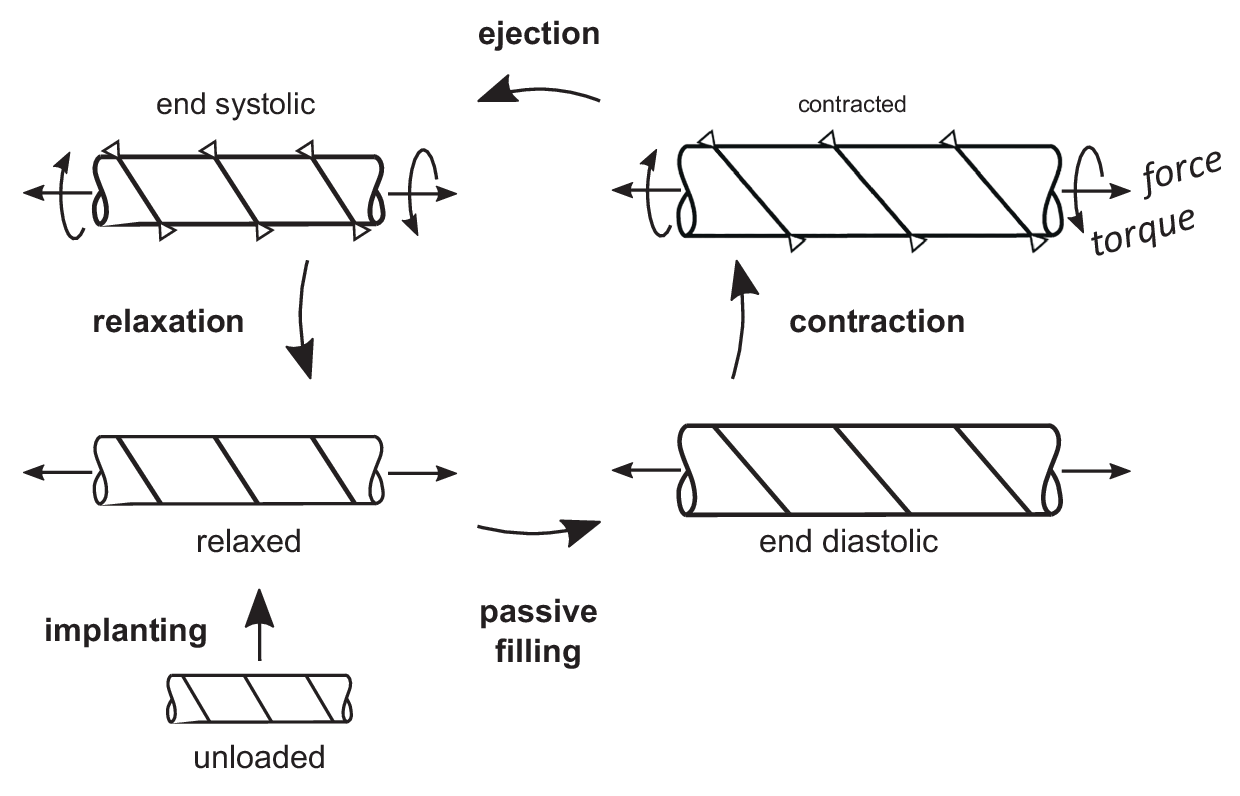
In this work, we used continuum mechanics to guide the design of a biomanufactured vascular conduit intended for children with single-ventricle physiology undergoing the Fontan procedure.
Rather than attempting to reproduce native anatomy, the goal was to design mechanical function — specifically to restore pulsatility and improve hemodynamic performance in a circulation that is otherwise largely passive.
The framework integrates:
- nonlinear anisotropic tube mechanics
- pressure–twist coupling and controlled torsional response
- fluid–structure considerations under physiologic loading
- implementation of the active constitutive model of Ohayon, Ambrosi, and Martiel within the tubular setting
- sensitivity and robustness analyses relevant to manufacturing and surgical deployment
The active constitutive formulation — originally developed by Ohayon, Ambrosi, and Martiel — plays a central role in capturing stretch-dependent activation and its coupling to structural architecture. Its implementation within this tubular framework enabled us to explore how designed geometry and material anisotropy translate into functional pulsatility under cyclic actuation.
What began as a mechanical abstraction — induced twist in layered tubes — became a design principle for a regenerative implant.
More broadly, this work reflects an effort to move from predicting biological mechanics toward prescribing mechanical architectures that shape physiological function.
I would greatly appreciate thoughts and discussion from the community.
Best regards,
Nir Emuna
| Attachment | Size |
|---|---|
| multi-axial loops in pulsatile conduits | 53.42 KB |