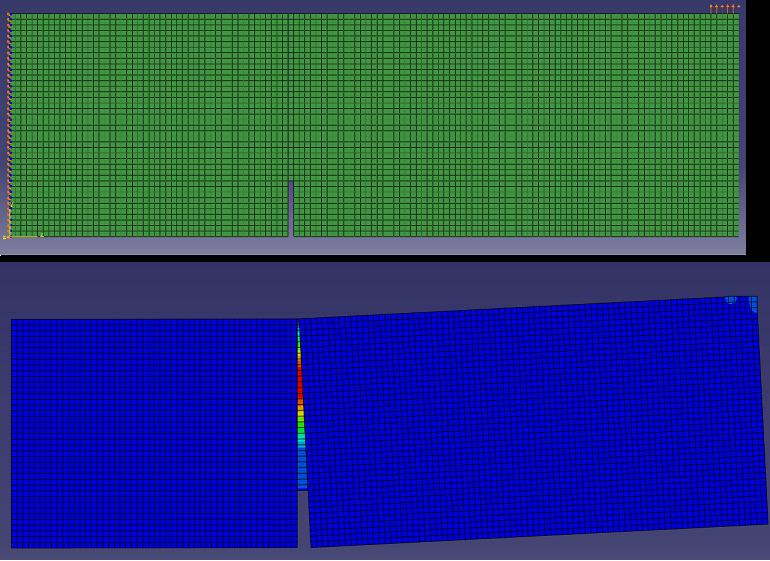
cohesive zone model

Problems with 3D contact/contact status

hi all,

I have some problems with contact elements in ANSYS.

My model is a cube of matrx containing two fibres with periodic boundary conditions. The interface between Matrix and Fibre is modeled with contact elements and cohesive zone law. 

In 2-D everything works out just fine when bringing up displacement in x-direction. Here is a movie I made of the Contact Status over the loadsteps:

http://dl.dropbox.com/u/4920002/2D_contactmovie_ContaStat_0.4.avi


Doing the same in 3D brings up some problems. The Contact status is not behaving as expected.


rdalmeya's picture

Dugdale -Barenblatt cohesive zone model outside the contact zone

Dear sir
        I am Ravi dalmeya doing Phd from Indian Institute of Technology,Kanpur (India). I am doing work on adhesive elastic wavy  thin film. I have completed 2-D Hertzian contact between cylinder and elastic half space using Abaqus. Now i want to apply Dugdale-Barenblatt cohesive zone model outside the contact zone and i do not know  how to apply  Dugdale-Barenblatt cohesive zone model outside the contact zone.Can you give me some suggestion?

Thanking you

Ravi dalmeya
Phd scholar
IIT Kanpur (India)
email  rdalmeya@iitk.ac.in


Need recommendation of PhD courses

Hi I am a PhD. Student at Aalborg University at Department for Mechanical and Manufacturing Engineering in Denmark. In short my PhD project treats modeling delamination damage in laminated fibrous composite structures under quasi-static and cyclic loading.


Simulating crack growth in Ansys implementing Cohesive Zone Model (CZM)

Hello, everyone!

Could you, please, help me with the following issue?

I’m trying to simulate a crack growth in an anisotropic media using cohesive zone model (CZM), and the results I get do not agree with my expectations, based on a common sense and simple estimations.

As I don’t yet feel myself on a safe ground with APDL, I make use of Ansys Mechanical, implementing command objects where needed.


Literature on CZM and it's implementation through FEM

Can anyone suggest some basic literature on Cohesive Zone Modeling and it's implementation through FEM? Most of the literature, I find, is on traction-separation behaviour and some simulation using a FEM package. I 'm interested to learn it's mathematical formulation and implementation through FEM. Can anyone help me?

Praveen.


Hi, is it possible to include a cohesive zone with temperature dependence behavior in abaqus CAE

Hi experts in both mechanics and abaqus,


Cohesive elements parameters

Dear All,

I modelled a beam with a hole and used cohesive elements on the possible crack plane.

When I run the model in 2D, it works very well and I can get the results pretty good.

Why running the same model in 3D (making 3D model and running it) has caused me a headach for a long time and I can not

get the results?

Any idea highly appreciated,

Thanks,

Parisa


Problems with cohesive zone. Does it make sence to use them here?

Hey I've got a beam and between two different materials i'm thinking to
put a cohesive zone with "weaker" material properties. Does it make
sense to use cohesive zone models?


My model is looking like this now. But I don't know what's wrong. It
seems taht the whole force/displacement is lost in the cohesive zone. 

If somebody can help that would be very nice

 here the pic: http://f.666kb.com/i/bnody4selpc6iml9m.jpg

Thanks for advance


cohesive zone model


Laurent Champaney's picture

cohesive zone modeling of interface fracture : comparisons

Hello,

(for completing R. Huang's post : http://imechanica.org/node/7396).

A  few years ago, some colleages (from Italy, UK and Brazil) and I proposed some comparisons of the behavior of cohesize zone models. This was presented during ECCM 2004. The paper is attached.


Angelos Irakleidis's picture

Cohesive material zone model and ABAQUS subroutines

Hello,

I'd like to ask if anybody knows if it is possible to use an ABAQUS usersubroutine that could vary some parameters (τmax, kn or ks etc) of the cohesive zone model of ABAQUS with the vertical pressure applied on the interface. The new ability of ABAQUS to support cohesive behaviour in contact surfaces seems very interesting and useful, however how could somebody simulate the interface under a compression - shear regime that may follow a Mohr-Coulomb type behaviour?

I tried to use the subroutine USDFLD. However I realised that it cannot be used with contact parameters as internal variables. Does anybody have any particular idea on this?


How to implement the Cohesive Zone Model in COMSOL?

Dear all,

I am trying to simulate a three-laminated composite considering the cohesive effect between the interfaces.

How can I implement this in COMSOL? Are there any Samples to follow? 

Thanks!

Binglun


Gouse's picture

Probelm with Abaqus/Explicit

Hi,

I am using cohesive elements to model the interface around a
circular inclusion. First I used Abaqus/standard I got proper results
but when I used same values with an amplitude curve (tabular, linearly
applied) to apply load quasi-statically in Abaqus/Explicit, I could not get a converged
solution. Field variables are oscillating and elements getting
distorted excessively. In Abaqus/Explicit I am applying load very
slowly but even though same problem persists.

Regards

Gouse 


Masayuki Wakamatsu's picture

Crack Length in Cohesive Element (ABAQUS vr 6.7.1) in pure MODE I case

Help! imechanica!

This might not be a smart question to ask, but if any of you can help me, it'd be great.

 I have a DCB (sandwitch specimen) with a cohesive element in the middle. Studying pure Mode I case, displacement is applied at the end of the DCB. Cohesive element works great (it fails when one reaches max separations).  But I am having a difficulity in extracting crack length (i.e. length of failed cohesive element) vs time step. I looked for Damage and Status commend, but it's not promising.  (I'm pretty new to ABAQUS....)

 If you have worked on cohesive elements, and know where those (filed maybe?) output of failed element lengths can be found, could you please help?

 Thanks~ masa


Dhruv Bhate's picture

Traction separation laws in Cohesive zone models - Some Questions

Hello! 

As a student who has spent a lot of time studying cohesive zone models in fracture mechanics, I have several questions that have bothered me over the past year or so, and I have not been able to find suitable answers to them. I am limiting myself here to questions related to the traction-separation law, which invariably forms the basis of CZM as it is implemented today. I am raising these questions in the hope that I can receive some response here, even if it means my question is invalid (as I suspect a few may be).  So here is my list:

----- 


Yuval Freed's picture

On the crack growth resistance of shape memory alloys

With the increasing use of shape memory alloys in recent years, it is important to investigate the effect of cracks. Theoretically, the stress field near the crack tip is unbounded. Hence, a stress-induced transformation occurs, and the martensite phase is expected to appear in the neighborhood of the crack tip, from the very first loading step. In that case, the crack tip region is not governed by the far field stress, but rather by the crack tip stress field. This behavior implies transformation toughening or softening.


Dhirendra Kubair's picture

Mode-3 spontaneous crack propagation along functionally graded bimaterial interfaces

This is a paper that has been accepted for publication in the Journal of the Mechanics and Physics of Solids from our group. The paper describes the combined effect of material inertia and inhomogeneous material property variation on spontaneous cohesive-crack propagation in functionally graded materials. The preprint is attached as a PDF.

Abstract- The effects of combining functionally graded materials of different inhomogeneous property gradients on the mode-3 propagation characteristics of an interfacial crack are numerically investigated. Spontaneous interfacial crack propagation simulations were performed using the newly developed spectral scheme. The numerical scheme derived and implemented in the present work can efficiently simulate planar crack propagation along functionally graded bimaterial interfaces. The material property inhomogeneity was assumed to be in the direction normal to the interface. Various bimaterial combinations were simulated by varying the material property inhomogeneity length scale. Our parametric study showed that the inclusion of a softening type functionally graded material in the bimaterial system leads to a reduction in the fracture resistance indicated by the increase in crack propagation velocity and power absorbed. An opposite trend of increased fracture resistance was predicted when a hardening material was included in the bimaterial system. The cohesive tractions and crack opening displacements were altered due to the material property inhomogeneity, but the stresses ahead of the cohesive zone remained unaffected.


Syndicate content